
By Wayne Allensworth
I form the light, and create darkness: I make peace,
and create evil: I the LORD do all these things.
— Isaiah 45:7
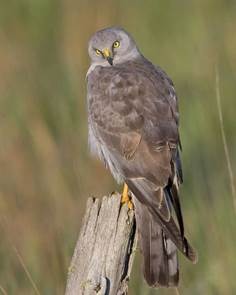
Summertime. In the mornings before the heat waves bear down on me, I take my quiet-time walk. And listen. And watch and pay attention. The doves coo as they take flight. And in the blue summertime sky, the harriers hover and watch. I walk beside a pond and remember these words:
He maketh me to lie down in green pastures
He leadeth me beside the still waters.
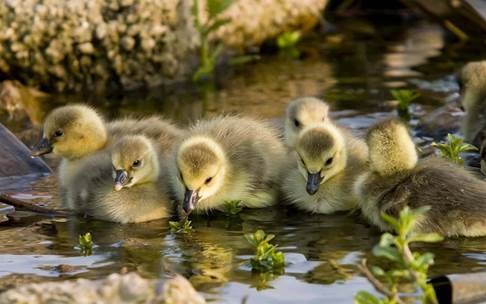
The waters are very still and, as with every morning, I look for a hen and her ducklings and count. She had seven and I thought they were all going to make it. They’ve grown and are getting closer to going out on their own. But this morning I got a small shock. I see the hen, but not the ducklings. When I spot them, they are hiding under hanging blades of grass on the bank. I see one … two … three … four … five … six. … One is missing. I’m relieved they are there, but sorry to see that one has apparently not survived.
So I go back to studying the trees and the flowers. One patch of wildflower blooms appears almost crystalline, like snowflakes. In the pasture behind our neighborhood, the longhorns are gathered by mesquite trees near the fence, their horns wide, the bull a massive presence among the cows. Sometimes a coyote emerges from the tall grass. One day he trotted beside me at a safe distance, occasionally turning his head to watch me. A screeching, red-tailed hawk sometimes circles the pasture. Cottontailed rabbits hop in the grass, taking refuge in the bushes. What is beautiful and alive is at once vital, but terrible and deadly.
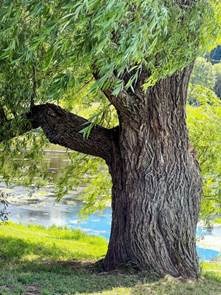
After counting the ducklings, I walk by a thick, bent willow tree. It has a companion on the far bank of the stream, and their twisted trunks make a fine portal, a gateway to gaze at the sun as it cuts through willowy cloud banks passing overhead like a school of flying fish. I think of those who have briefly seen the other side, passing through a tunnel with a light ahead, feeling a reassuring presence beside them. And in such moments, I can see things more clearly, everything in its dimensions on a plane with depth and contrast. It’s an awareness that eludes so many of us caught in a race to nowhere. I touch the scaly bark of the thickest willow. On its limbs, I see the shells of molted insects, renewed, still themselves, but different. Each one of us is like that, a ship of Theseus, our parts constantly changing, but maintaining a continuity of identity. Life is a paradox.
When the wind ever so gently rustles the leaves in nearby tall oaks, I feel the airy breeze and spread my arms, thinking of eternity and the flow of time, which is motion and change, a river that is itself, with enough continuity to preserve a sense of stability within the currents. Like waves, we and the animals and the plants rise up and grow and dissipate, only to be followed by more waves. Mountains are like waves, but waves that gather their force and rise and dissipate at rates of geological time we cannot see.
The Gnostics believed that the earth, the material world, was evil, created by a demi-urge who trapped us in our bodies, so that we had to seek hidden wisdom to escape the world and our material bodies. The world was a veil of tears we only wanted to leave. At times in my life, that seemed credible. But I learned that even grief can be sweet, like the sweet sorrow of memory. We can only grieve what was worthy of love. And the limits of life and duration and flow are the boundaries that make us. We are embodied beings, and the body itself is a boundary that distinguishes and defines our soul — our bit of consciousness — from another. We wouldn’t have developed our personalities, our identities without those boundaries. We can’t stop the flow of existence, because that flow is life itself that gives us an opportunity to love and experience the good and the bad. Both are necessary. A victory without the chance of defeat wouldn’t be a victory at all because nothing is at stake. Without struggle, there is no self-transformation.
As for that sweet sorrow of memory, I often think of all those who I’ve known in my life. I see them not as flat representations but as fully alive, moving, living in a world of depth and experience. I wish I had done better for some of them. Others I simply miss, and the memory is what brings them back to me. I don’t try to forget even the unpleasant memories. Some may have been people I only knew for a short while, but their memory is lasting. One act of kindness. One justified rebuke. I remember because in memory there is meaning.
On my 50th birthday, my family had a party for me at the house in which I grew up. My parents were still alive, and so many of the people that affected my life showed up and shared memories. I was moved. We remembered good years, very good years, as well as sad ones. We remembered those who were gone. It was a day when I felt so alive, like those times when you look at a beautiful dusk, or stand on a mountaintop, or enter a magnificent cathedral. There is a rush of heightened awareness, and you see things with more depth. No matter what, rejoice in being alive.
Certain strands of thought in Christianity come close to that dualistic dichotomy. The ones that see Satan as the ruler of this world. Experience has taught me that the truth is more complex, that the apparent contradictions coexist. Indeed, they compliment each other. No Devil, no God, was an aphorism I learned somewhere. Good and evil, happiness and sorrow, joy and suffering, striving and struggling are what can transform us. They burn away the trivial. Anything achieved without a struggle is diminished in value. It is a hollow thing — empty and meaningless. A life without striving would be one of despair, even more than one of relentless suffering and loss. Death is not something that any of us — I think of the transhumanists and their search for immortality as cyborgs in what appears to me as a sci-fi nightmare — should fear. Yet life is the reason we are here. Both things are true.
Anger at God for suffering is pointless, as suffering is baked into the cake along with joy. It can’t be some other way. So many people struggle with that. Why so much suffering? Why am I here? What is the purpose? But life is its own purpose and all the smaller things, those transformative struggles, are wrapped up in it and can’t be divided from it. Jesus himself struggled with that in the garden.
Yet, we should think small. Ordinary people have limited opportunities to change the vast panorama of historical events. Try to remember that when you see people come and go in your life. Each one of them has a story, a family, a struggle, a cross to bear, and maybe, just maybe, something to offer. We can affect the small world we live in, for good or ill.
I’ll try to make it good.
Please consider supporting American Remnant: A green “Donate Today” button has been added at the end of each article (see below) appearing on the website. If you value what AR is doing, please consider supporting the website financially. $5, $10, or any amount that you can afford. Regular donations would especially be appreciated. Thank you!
Chronicles contributor Wayne Allensworth is the author of The Russian Question: Nationalism, Modernization, and Post-Communist Russia, and a novel, Field of Blood. For thirty-two years, he worked as an analyst and Russia area expert in the US intelligence community.


