
By Paleo Pundit
The Office of the U.S. Trade Representative recently posted a cheerful claim that factory construction is booming. If this is to be believed, supply chains are returning to the American Heartland and a manufacturing resurgence is ahead. It’ll be like nothing you’ve seen before — the Dawn of a Golden Age.
As I work with these sort of data, I offer a more nuanced take from the How to Lie With Statistics” department.
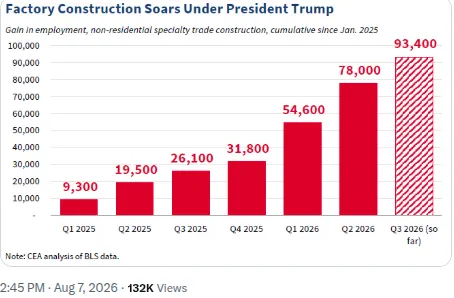
One of the highlighted metrics from the recent jobs report was a substantial gain in employment among “non-residential specialty trade construction” workers since the beginning of 2025, which here is dumped into a bucket called “factory construction jobs.” The implication is that tariffs and trade policy are delivering a manufacturing renaissance that will soon be measurable in hard hats walking around factory floors in the Midwest.
A closer look at Bureau of Labor Statistics data and the underlying categories tell a somewhat different story. The key phrase is “Gain in employment, non-residential specialty trade construction.” BLS’s specialty trade contractors category (NAICS 238) covers electricians, plumbers, HVAC technicians, concrete contractors, site preparation crews, structural steel workers, and similar trades. Their work is not limited to factories. They work on data centers, warehouses, hospitals, offices, retail buildings, infrastructure-related facilities, commercial renovations, and yes, manufacturing plants.
The employment gain itself is real. Nonresidential specialty trade contractor employment has risen a bit more than 90,000 jobs (depending on the exact starting month and seasonal adjustment) since early 2025, bringing the category to the vicinity of 2.9 million workers. That is progress. But it is modest relative to the size of the overall construction workforce and the scale of the construction workforce and the scale of the claimed manufacturing boom.
Investment in semiconductors, battery plants, pharmaceutical facilities, automobile plants, and metals operations is rising. Many of these projects are the kind of capital construction traditionally labeled “factory” work. Yet the nature of large industrial projects means the planning, permitting, financing, and early construction phases typically stretch over years. A significant portion of the current activity was already in the pipeline well before recent tariff announcements. Completing projects that were authorized and funded under earlier industrial policy and certainly does not prove a new policy regime is the proximate cause.
More importantly, the evidence strongly suggests data centers have been a major (dominant?) contributor to the recent surge in nonresidential construction employment and spending. Multiple reports, including The Wall Street Journal’s coverage of recent jobs data, have explicitly linked gains in nonresidential specialty trades (especially electricians and related skilled trades) to the AI-driven data-center buildout. Private data-center construction spending has climbed dramatically. Investment in data centers is now larger than all the investment in public infrastructure, which might explain why you keep hitting potholes.
Census Bureau and industry data show manufacturing construction spending falling meaningfully from its 2024–early 2025 highs even as data-center and related infrastructure spending accelerate. Contractors report long backlogs concentrated in data-center work, with premium wages for electricians and other trades being pulled into these projects. This helps explain why nonresidential specialty trades post gains, while other segments of construction remain mixed and while traditional factory starts cool.
Another salient question; Are we now calling data centers factories? Classification systems are flexible enough that almost anything is possible. Donut shops, for example, that bake on-site are classified as manufacturers. Data centers are commercial or office-related structures in many statistical buckets, yet the electrical, cooling, and structural work required to build them shows up in the same specialty-trade employment series used to advertise a factory boom. The statistical category is broad but political framing is narrow by design.
None of this denies that construction employment in nonresidential specialty trades has improved or that large capital projects of various kinds are underway. But the significant fact is this: the government’s treating a multi-purpose employment series as a proxy for “factory construction jobs” attributable to a specific trade policy, while downplaying the outsized role of data centers and the multi-year lead times of huge industrial projects is a selective presentation.
That is lying with statistics — the manipulation of data for political ends.
Readers can follow Paleo Pundit on Substack.


