
By Wayne Allensworth
The long, hot summer has dragged on. I got out early to walk my trail, watch the animals, and survey the trees. Some have thick bark, like plates of armor. Others are smooth. I examine the leaves and note that the willows near the pond seem to be surviving harsh sunny days, though the creek bed has dried up. The Kites I have enjoyed watching through spring and summer have already flown away, bound for South America.
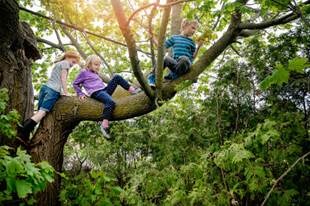
I often see children at a playground. Sometimes they even ride bikes, not the electric scooters that are replacing the venerable bicycle. But I never see kids climbing trees anymore — a casualty of the increasingly stringent parental focus on safety above all. That’s too bad. Risk is part of the adventure of life, of preparing for the great trek when one leaves home and steadily becomes an adult by taking on responsibility — and dealing with danger and risk. Nothing ventured, nothing gained.
It’s just a small mental step for me to take myself back to that place again.
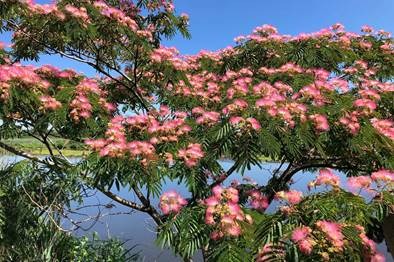
My father built our modest home on a half-acre lot in the 1950s. He and my mother planted trees and flowers, and Daddy dug a pond he filled with goldfish, and built brick planters for my mother. I remember most vividly the whitish trunks of the mimosa trees he planted in a row along the front of the yard. The mimosas seemed exotic and tropical. They grew with wide, thick limbs that became a makeshift crow’s nest, especially the big one near our gravel driveway. I could sit on a thick branch and survey our domain.
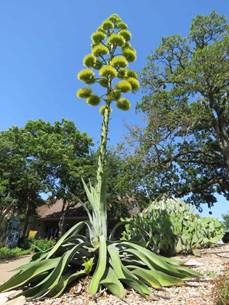
Across the driveway was a century plant with its rubbery, wide green cactus-like wings spreading out from a tall shaft that eventually bloomed into an exotic spray. It died sometime after that, as they do, and the thorny wings dried away. At the corner of the house was a kumquat tree, a strange fruit bearing plant with waxy deep green leaves that looked like a magnolia.
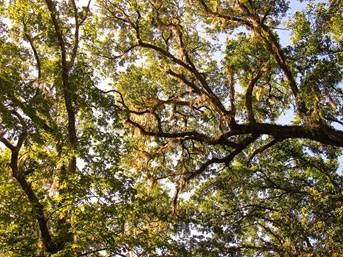
My father planted live oaks that grew vast canopies over the yard that was covered with St. Augustine grass. As a big live oak in our front yard matured, people guessed that the tree was a hundred years old. Daddy smiled and told them, no, I planted that tree. A Chinaberry tree grew outside our bedroom window. The oak over the fishpond grew thick and gnarled and you could sit on the limb over the pond. A willow tree’s thin branches would wave in the wind like a sea tide that would turn when the winds shifted. Daddy cut it down because Woodboring beetles burrowed deep into the trunk, destroying the tree.
My father planted a grape vine that covered a fence by the garage, and he could make wine from its fruit. I loved our pecan trees and every year we gathered the pecans in buckets as they fell. We sat on the porch, shelled them and ate the sweet pecan halves. My younger brother climbed so high in a tall tree in our back yard that he couldn’t get down, and Daddy brought out an extension ladder to rescue him as the tree limbs wavered in the breeze.
When a hurricane blew in, the trees whipped in the wind, and we gathered the broken branches. Our house was built on the highest point in the area, and we were preserved like an island when the inevitable floods came. Then the drainage ditch in front of our yard filled with water that was clear and cold, and vast armies of crawfish built their mud castles in the water.
In fall, the yard was carpeted with thick layers of oak leaves that we boys would rake into vast piles and sometimes jump in them, throwing the leaves around. Our yard seemed like a vast realm of adventure with that little house nestled among the trees. We built forts and watched the delicate flight of butterflies and got stung by bees and drank well water and watched our mother pin up wet clothes on a line near a metal swing set that eventually rusted away.
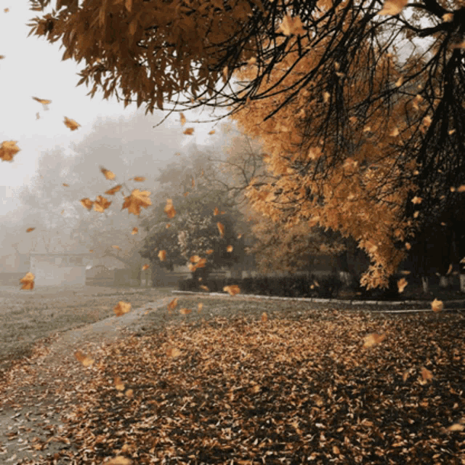
But as years went by, the trees remained.
The summer of life has passed us by and the old house and the trees are gone. The trees of summer, the bare limbs of fall. The kumquat, the Chinaberry, the mimosa, and the pecan. Trees of imagination and adventure. Planted by my parents in a far different place and time. I remember. This is my memorial for the trees.
Chronicles contributor Wayne Allensworth is the author of The Russian Question: Nationalism, Modernization, and Post-Communist Russia, and a novel, Field of Blood. For thirty-two years, he worked as an analyst and Russia area expert in the U.S. intelligence community.
Please consider supporting American Remnant: A green “Donate Today” button has been added at the end of each article (see below) appearing on the website. If you value what AR is doing, please consider supporting the website financially. $5, $10, or any amount that you can afford. Regular donations would especially be appreciated. Thank you!


