
By Darrell Dow
Samuel Huntington’s The Clash of Civilizations and the Remaking of World Order, offered a framework for understanding post-Cold War global politics. Rather than ideology or economics driving conflict, Huntington argued that the world would reorganize along cultural, religious, and civilizational lines. He presented a map dividing the globe into major civilizations — Western, Orthodox (centered on Russia), Islamic (Iran), Sinic (China-led), Hindu (India), Latin American (Brazil as core), Sub-Saharan African, and Japan — each with core states that provide internal order and coherence.
Building on his influential 1993 Foreign Affairs article, Huntington described a world in which future tensions would erupt along “fault lines” where civilizations meet. Critically, he urged a prudent foreign policy that seeks out sources of order from other civilizations and avoids unnecessary conflict. In a multicivilizational world, he insisted, the surest path to peace was not universal liberal democracy imposed from Washington, D.C., at the point of a bayonet but instead pragmatic coexistence. Core states could serve as legitimate “sources of order” within their own civilizations through cultural affinity, not external meddling.
In the short term, said Huntington, the West should strengthen its own unity, cooperate with the “swing” civilizations of India, Japan, and Russia and prevent local fault-line wars from escalating into broader clashes. In the long term, Western leaders had to abandon the illusion of a universal civilization and instead “learn to coexist with the others.” His “abstention rule” was explicit: Core states of one civilization must refrain from intervening in the conflicts of another. Violating this, he warned, was “probably the single most dangerous source of instability and potential global conflict.” The West’s principal responsibility was to preserve its own unique qualities, not remake the world in its image. An international order based on civilizations, not imposed universalism, offered the best safeguard against world war.
Yet President Donald Trump has followed his predecessors. Moving in the opposite direction, he is actively undermining the very foundations essential for Western survival in a multicivilizational world. Transatlantic relations with Europe have been repeatedly strained by abrupt policy shifts, public rebukes of NATO partners, and unilateral decisions that have left traditional allies questioning American reliability. Similar damage has been inflicted on the broader Anglosphere — Canada, the United Kingdom, Australia, and New Zealand — where long-standing cultural, economic, intelligence, and security ties have frayed under the weight of trade disputes, diplomatic slights, and perceived abandonment of shared interests. Even more dangerously, the administration’s approach has alienated adjacent civilizations that Huntington explicitly urged the West to cultivate: Japan, whose strategic alignment with the West has been a stabilizing counterweight to Chinese assertiveness, now finds itself navigating heightened uncertainty; meanwhile, relations with Russia, the core state of Orthodox civilization, have deteriorated into outright hostility rather than managed coexistence. Thus has Trump fractured the very coalition the United States must lead. He has accelerated the civilizational rallying against the West that Huntington warned would follow from such strategic myopia.
Huntington singled out the Islamic world in general and Iran in particular as a potential flashpoint. He viewed the 1979 Iranian Revolution as an example of modernization without Westernization. Iran, though Shi’ite and therefore limited in its ability to lead the Sunni-majority nations, actively sought military and ideological influence. Huntington noted Tehran’s push for nuclear, chemical, and biological weapons across Muslim states and predicted deepening military ties with China. The two nations would form a “Confucian-Islamic connection” that would challenge Western dominance. These dynamics illustrated the “centuries-old military interaction between the West and Islam” turning more virulent.
Fast-forward three decades, and Huntington’s map appears prophetic. The non-Western civilizations he identified are not merely resisting the West. They are coalescing. A prime illustration is the expansion and activism of BRICS. Originally Brazil, Russia, India, China, and South Africa, the group has grown dramatically. By 2024 it formally added Egypt, Ethiopia, Iran, and the United Arab Emirates; Indonesia joined in 2025, with Saudi Arabia also incorporated. The expanded bloc now accounts for roughly 45 percent of the world’s population and between 35 and 44 percent of global economic output.
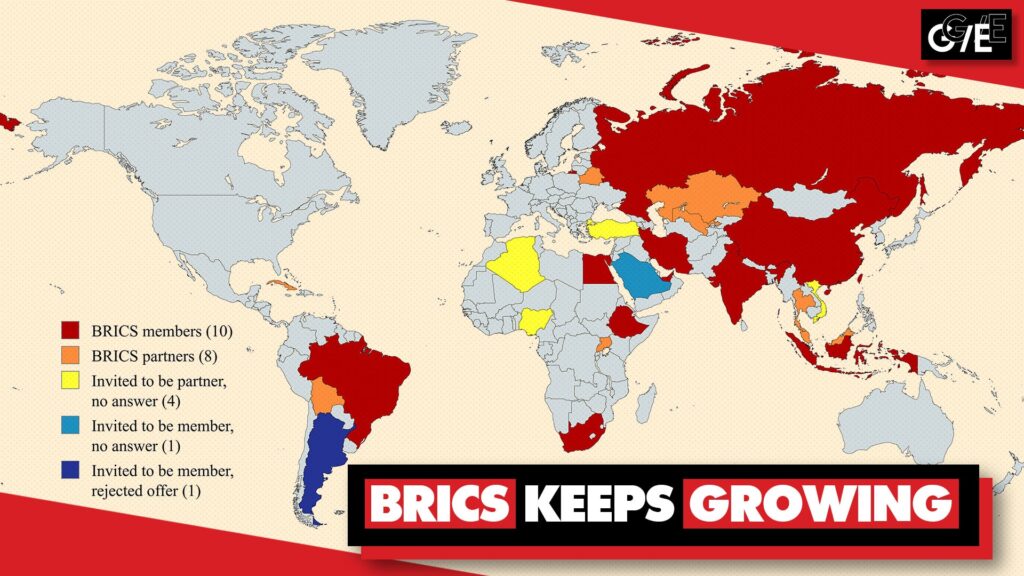
— Geopolitical Economy Report
These states represent precisely the core actors of Orthodox (Russia), Sinic (China), Hindu (India), Islamic (Iran, Egypt, UAE, Ethiopia), and Latin American (Brazil) civilizations. Their cooperation is no accident. Western policies, particularly the sustained pressure on Russia over Ukraine, sanctions regimes, and confrontation with China and Iran, have had the effect of forging common cause among them. Brazil, as Latin America’s leading state, notably declined to join Western sanctions against Russia. The result is a visible alignment of civilizations that Huntington described as potential rivals to the West but not necessarily destined to unite against it. History is taking shape before our eyes.
Nowhere is this dynamic clearer than in the Russia-Ukraine conflict. Huntington viewed Orthodox civilization as distinct from the West, with Russia as its core state. The war can be read, in his framework, as a tragic civilizational struggle — an attempt by the West to pull Ukraine westward, clashing with Russia’s determination to maintain its sphere within Orthodox cultural space. Rather than a simple border dispute, it fits the pattern of fault-line conflict Huntington anticipated. Far from isolating Russia, the episode has accelerated its partnerships with China, India, Iran, and others, precisely the cross-civilizational coalition he warned could emerge if the West intervened too aggressively in another civilization’s affairs.
Underpinning these shifts is the ideological failure of post-Cold War liberalism. A generation ago, the “end of history” thesis celebrated liberal democracy’s triumph and the unipolar moment. Yet that confidence proved illusory. When exported as a universal creed rather than a Western particularity, liberalism became an ideology of overreach. Seemingly convinced of their own moral and historical inevitability, Western elites pursued policies that disregarded the cultural boundaries Huntington mapped so carefully. Instead of hegemony, the result has been a dying and decaying West increasingly viewed by rising civilizations as a common challenger rather than an indispensable partner. The Ruling Class’s delusions — prioritizing ideological transformation abroad over prudent realism — have driven non-Western peoples together in self-defense.
Huntington was not an isolationist or defeatist. He believed the West could thrive by renewing its own civilization while practicing strategic restraint elsewhere. He would likely view today’s BRICS convergence and the Russia-Ukraine entanglement not as proof that conflict is inevitable, but as confirmation that ignoring civilizational realities invites precisely the backlash he feared. Iran’s role within the Islamic bloc, its ties to China, its inevitable rise as a consequence of stinging the United States, and the broader non-Western economic and demographic weight now concentrated in BRICS, echo the patterns he outlined in the 1990s. We are moving inexorably to a multipolar and multicivilizational model. The dream of Babel in the form of American Imperium has crashed on the rocks of history. Unable to defeat goat-herders of Iraq and Afghanistan, we are witnessing the death rattle in Iran.
The story of the future, as Huntington saw it in the 1990s, was never guaranteed doom. It was a call for a realism that recognized civilizations as the primary units of global order, respected their internal sources of legitimacy, and avoided the hubris of remaking others. The West’s recent trajectory suggests we have done the reverse. Whether this leads to managed multipolarity or deeper confrontation depends on whether Western leaders finally absorb Huntington’s central lesson. In a world that is once again multipolar and multicivilizational, coexistence is not surrender. It is the only viable path to peace. The map Huntington drew remains the clearest guide we have. The question is whether we are willing to read it honestly before the fault lines widen further.
Darrell Dow is a contributor to American Remnant


