By Wayne Allensworth
Decembers are strange in these parts. It’s cold — in the 30s — but the leaves have not fallen. Fall and winter mingle. I enjoy watching the leaves turn to reds and oranges and even purplish hues. The breeze is beginning to take some of them away, but they have a way to go before they all pile up in yards and on the trail I walk each morning.
The pond shimmers in the morning sun, and I pause to watch the bright waves flash. The sun is so bright, the Moon hanging in the morning sky like a great Christmas ornament. I look for the birds I’ve grown used to watching. A huge gray heron who stalks his prey along the shore. A crane, as white as the winter snows we seldom experience here. And a particular duck. A male mallard with a bad leg. The orange limb juts out from the right side of his body as he swims with one webbed foot. He can fly and seems well enough otherwise, swimming with the others, trailing just a little behind.
I’ve learned to stop thinking of myself as something separate from the pond and the sky and the animals. We are not things wholly complete in ourselves, but manifestations of a vast and glorious creation, a living organism, not a machine, not dead matter we are here to simply observe, exploit, and manipulate. We become ourselves by interacting with the world around us, with other personalities, with the teeming life we see everywhere. Letting go of that, of seeing oneself from the inside, sealed off in a solipsistic manner that is so characteristic of our age, was liberating. It is pure experience, unhindered by over analyzing each entity as if it were under a microscope. Embracing the cycle of life and death and rebirth not as a meaningless nullity, but as a gateway to understanding.
It’s that time in my life and in the lives of my contemporaries, when the cycle makes itself impossible to ignore. Illness is more common. I hear news of it often enough, and of death. My own infirmities are enough to concentrate the mind, so to speak, but I don’t dwell on them, as I’m at peace now in a way I’ve never been, in trusting, not “knowing” in the sense of calculation or precision, but sensing, observing, and trusting that the next stop ahead is not the end, but a passage to a new stage of being.
Looking back at the flow of life, that was something one doesn’t consider when pure experience is so exhilarating. When we are young, each experience is new. But our years are marked, if one is paying attention, by a growing sense of life’s gravity, and that each life affects so many others around it, including in the natural world. Suffering is as inevitable as the joys we experience. Pain as much as ecstasy. The good in our lives and the bad are mutually dependent dipoles in a universal experience. Trial, success, failure, coping with success and coping with disaster. And hopefully learning. We would be automatons without them.
I’ve learned a lot from reading of mystics who sought direct experience of God. Those dazzling moments of contact with the infinite that so many of us have had in a fleeting way that leaves us changed. There’s a balance one tries to strike between the necessary solitude of the anchorite and the necessary communal lives that create human society. It was the calling of the few to seek that mystery as the path of their lives, but we can learn from it. Christ lived that experience to the fullest as a man whose divinity was more than the spark all of us contain.
Looking back and looking ahead. It’s a mistake, I think, to want to “know” the divine instead of experiencing it — as if it were another equation with a formulaic solution, with tight and precise linguistic constructions. Trying to do that is like trying to catch lightning in a bottle or to try and experience the vastness of the cosmos via a microscope — though it’s in there, too. Every particular a fractal aspect of infinity. And it tends to reduce faith — trust — to a series of propositions that easily become an ideology and not a path to be followed. Formal theology is something like grammar, I think. It’s good to teach the young, to give them a framework, a coat hanger to hold the cloak of the intellect on. But faith is not something that can be intellectualized. The rules are intended as a guide, but it is their spirit, not the letter, that must be followed to achieve the next stage. The greatest artists and poets, and the greatest spiritual guides, always transcend the rules. It’s difficult for humans grasping for certainty to see. Jesus constantly clashed with the Pharisees about the letter and the spirit of the Law. He fulfilled it by transcending it. Arguing over those proverbial angels dancing on the head of a pin is a game that is too easy for our Will to Power to exploit. To determine what is supposedly all one way or all the other — who is completely right, who is completely wrong. Context and circumstances matter. And Jesus let the Pharisees know that. He taught the paradox that is at the center of his message: You must lose your life in order to gain it. Take up your cross. Let go and become more than you ever thought you could be.
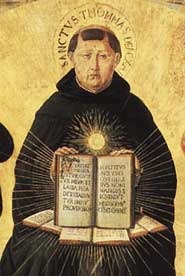
The great scholastic Thomas Aquinas never completed his magnum opus, his Summa Theologiae. He had a mystical experience, a direct experience of that which he had so long sought to reduce to writing, to explain in logical constructs. And he realized that medium had been exhausted for some time. He never wrote again. What he had experienced could not be expressed in ordinary language or reduced to a formula or set of propositions. The great theologian’s life changing experience took place on December 6, 1273, the feast of St. Nicholas of Myra. Aquinas commented that after that experience during Mass, he felt that all he had written was “like straw.” “I can write no more.”
Looking ahead, I anticipate a great experience, a transformation. For now, I hope to hang around this world a bit longer, to interact with my grandchildren, to be a part of who they become. And to learn from them. The aim of old age is to sharpen the bit of wisdom one has hopefully accumulated. To share it. And to never stop learning. Like Aquinas, I sometimes think that my writing is like so much water under the bridge. Especially as one sees ahead on the horizon that inexpressible experience that awaits us. But the journey was worth it. In struggling with the big questions, we can finally arrive where we started, with pure experience.
Chronicles contributor Wayne Allensworth is the author of The Russian Question: Nationalism, Modernization, and Post-Communist Russia, and a novel, Field of Blood. For thirty-two years, he worked as an analyst and Russia area expert in the US intelligence community.
Please consider supporting American Remnant: A green “Donate Today” button has been added at the end of each article (see below) appearing on the website. If you value what AR is doing, please consider supporting the website financially. $5, $10, or any amount that you can afford. Regular donations would especially be appreciated. Thank you!


