
By Darrell Dow
One annoyance of age is getting to watch the same people announce the same permanent political realignment every few years. Karl Rove had one. So did Barack Obama. After November 2024, Donald Trump supposedly had one, too. A durable working-class, multiracial coalition had arrived, the Democrats were finished, and the future belonged to the Republican Party!
That future lasted about as long as Donald Trump’s campaign promises.
The Republican thrashing in 2026 should halt that nonsense, at least temporarily. But soon enough, GOP consultants and paid influencers will explain that the problem was poor messaging, insufficient loyalty, or a handful of “Woke Reich” podcasters who somehow became more powerful than the president. “Stolen election” conspiracies will be floated, a coping mechanism and therapeutic release for the “Right” to rationalize demographic dispossession and policy failures.
Trump won in 2024 because Americans wanted their country and their economic prospects restored. But instead they received another round of economic insecurity at home — rocketing inflation, a languishing job market, and soaring interest rates — while Washington busied itself kidnapping foreign leaders, threatening allies, and unleashing a regime-change “war” in Iran. White voters shifted away from the Republicans in 2026 and young voters moved away even more dramatically. A coalition assembled around dissatisfaction with the Regime discovered that its supposed champion had joined it.
The question was no longer whether Trump could annoy the people his voters disliked. The question was whether he could improve their lives. Voters provided their answer.
The Arithmetic Republicans Keep Forgetting
Throughout my adult life, Conservatism Inc. and GOP elites have been braying that Hispanics are “natural conservatives” and pandering to black voters with think-tank schemes like school vouchers and enterprise zones, or in our more debased era, by hanging out with Diddy and talking about Nicki Minaj’s ass.
But at root, politics is about identity, not ideas. Demography is determinative. People are policy and politics is always tribal.
In 2024, President Trump built a broad coalition that included 46 percent of Hispanics and 40 percent of Asians, along with a majority of Arabs in places like Michigan. Those gains were always ephemeral. The GOP, as VDARE.com called it, is the GAP — Generic American Party. It is dependent on white voters. Trump should have stabilized his political coalition after Election Day and given his voters a stake in his success.
2024 NBC Voter Poll
First and foremost, that meant taming the inflation monster that Trump unleashed in a panicked response to Covid and President Joe Biden worsened. But it also meant hard-nosed immigration control, not just by sealing the border from invasion and mass deportations, but by stopping legal immigration and ceasing the importation of foreign workers via H-1B visas and implementing EVerify. It also meant pursuing the economic nationalism for which I’ve argued for years, and directing investment back into the towns and regions that had spent decades watching jobs and capital leave.Two years later, those non-white blocs had returned to their more normal voting habits. More ominously, whites cast significantly fewer ballots for Republicans.
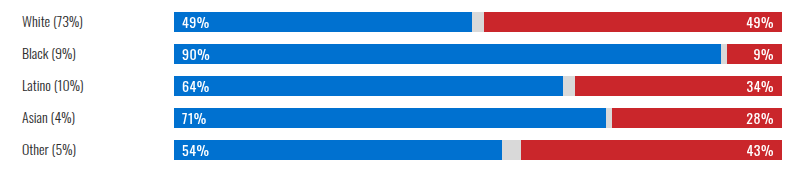
GOP slippage occurred among all white demographic groups — urban, suburban and rural; highly educated professionals and the working classes; young and old. The damage was not localized.
| Voter group | 2024 Democratic / Republican vote | 2026 Democratic / Republican vote | Change in party margin toward Democrats |
| White voters | 42 / 57 | 49 / 49 | 15 points |
| White men | 38 / 60 | 45 / 53 | 14 points |
| White women | 46 / 53 | 52 / 46 | 13 points |
| White voters without college degrees | 32 / 66 | 39 / 60 | 13 points |
| White college graduates | 53 / 45 | 60 / 39 | 13 points |
| Voters aged 18–29 | 54 / 43 | 73 / 25 | 37 points |
| Voters aged 30–44 | 51 / 47 | 62 / 36 | 22 points |
While the demographics of the country are changing rapidly, whites are still overwhelmingly represented among voters. Thus, their shifts in voting have significant implications. Democrats outpaced the GOP by 12.4 percent among the entire electorate. If Republicans had kept the share of white votes they won in 2024, that margin would have been only about 1.5 percent.
In 2024, Republicans won white voters 57 percent to 42. Two years later, they split those voters with Democrats, 49 percent apiece. White voters made up 73 percent of the 2026 electorate, so the change in the margin among whites translated into nearly an 11-point swing overall. Keep the 2026 electorate and the way every other group voted exactly, as shown in the exit polls, and restore the 2024 split among white voters and the result is roughly 50.2 percent for Democrats and 48.6 for Republicans. Democrats still win, but what looked like a 12-point rout becomes a close race.
Nor can the party explain the defeat as the work of suburban white women alone. White men moved. White voters with degrees moved. White voters without them moved. The losses extended across the divide between the suburbs and the rural areas, which swung 15 percent toward the Democrats.
Republicans also lost ground among minorities, independents, and young voters. The scale of the youth reversal is also striking. NBC News put the Democratic advantage among voters under 30 at 11 points in 2024 and 48 points in 2026. Young people were a smaller share of the midterm electorate, so their movement cannot by itself explain the entire defeat.
The numbers reinforce the conclusion that the 2024 coalition was conditional. As well, they make post-2024 talk of a permanent Republican generation look ridiculous.
Young Men Wanted A Future
A particularly revealing Republican misunderstanding concerned young men. A taste for irreverent podcasts, contempt for woke moralizing, and an aversion to being hectored about masculinity were treated as evidence of permanent partisan attachment. Once a young man posted the right meme, Republicans assumed his next forty years of ballots were settled.
But cultural revolt does not eliminate material needs. A man might mock the university diversity office, but he still needs a job. Someone who enjoys watching Trump humiliate a journalist still needs to find a reasonably priced apartment.
When I wrote about Gen Z, I emphasized that older Christians and conservatives should take its circumstances seriously rather than dismissing every grievance as pure resentment, immaturity, or “father hunger.” Older Americans who acquired homes under very different conditions should be careful about treating every struggling young person as an object lesson in failed character. The ordinary ambitions of a young man aren’t mysterious. He wants useful work, a wife, children, a home, and a reasonable prospect that his hard work will be rewarded with stability and respect. Any right-wing movement should recognize these ambitions as the foundation of the social order it claims to defend.
Instead, it offers lectures about personal responsibility and GOP politicians attack them while treating economic conditions as somebody else’s problem. Just work harder, borrow more, move again and stop buying those burritos and avocado toast. Perhaps a 50-year mortgage will solve the difficulty. If the arithmetic still fails, watch another John Doyle video or read a Captive Dreamer post about how civilization depends on voting a straight Republican ticket.
That sales pitch has limits. Vibes aren’t a substitute for a job.
CIRCLE’s post-election analysis offers another view of the reversal. Its updated figures put Democrats ahead among White youth by 61 percent to 36, including 54 percent of white men. These figures come from a different survey analysis than NBC News’s tables, but point to the same conclusion that Republicans did not secure the generation they had just finished congratulating themselves on winning.
An Economy That Leaves Men Waiting
Trump’s mandate was to tame inflation and spur job creation. How has he done? Prior to the invasion of Iran, inflation stood at 2.4 percent, regular gas averaged $3.04 per gallon, diesel about $3.72, and the 30-year mortgage rate hovered at 5.98 percent. As of early November 2026, inflation has risen to 3.7 percent, regular gas is around $4.15, and diesel has climbed sharply to about $6.29. The 30-year mortgage rate: 7.18 percent.
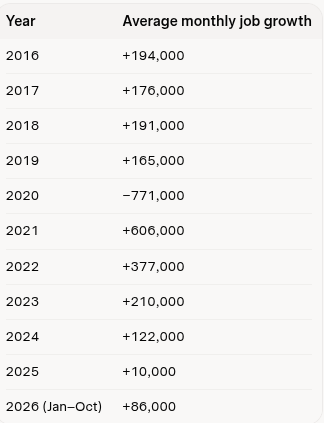
What about the job market? Is it booming? In 2025, an average of less than 10,000 new jobs per month were created. This year, the number has rebounded slightly to 86,000 per month, though I suspect this figure will ultimately be revised downward considerably. This is anemic job creation when compared with even the recent past, including Trump’s first term.
Source: U.S. Bureau of Labor Statistics via FRED®
More alarming is that few of these jobs are going to men. In August, the New York Post reported an analysis by economist Justin Wolfers that shows women accounted for 403,000 of the 468,000 net payroll jobs added since Trump’s second inauguration. Men accounted for 65,000. Women’s share was approximately 86 percent. Trump, of course, bragged about this “accomplishment.”
Looking at the full Bureau of Labor Statistics data set, women accounted for 77 percent of net U.S. nonfarm payroll growth from January 2025 through October 2026. Payroll jobs held by women rose by 791,000, compared with 234,000 for men. That’s roughly four out of every five net jobs added (see below). This is a striking imbalance for an administration elected in part on promises of industrial revival and “ending DEI.”
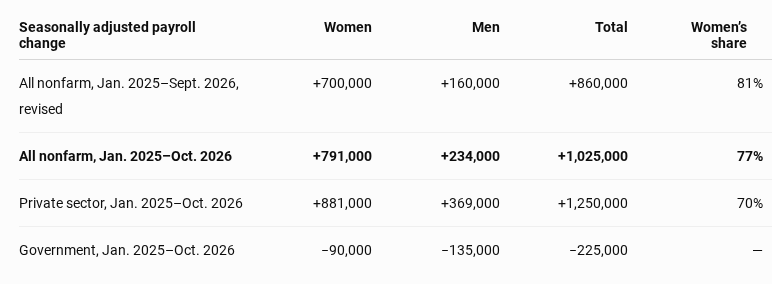
Much of the divergence reflected growth in health and education services alongside weaker employment in industries that employ more men — mining, construction, and manufacturing. Nobody should begrudge a nurse her job. Aging Boomers need care, and women earning a living are not responsible for Washington’s policy failures.
The political problem is that industrial renewal was supposed to offer something more substantial to the men whose working lives had been disrupted by the neoliberal economic settlement of the last 30 years, which Trump was elected to renegotiate. If that renewal remains a chimera while their employment gains remain thin, men are entitled to notice.
They are also entitled to distinguish a paycheck from an investment announcement. A proposed factory, often a figment of Trump’s imagination, is not a functioning employer. New factory construction spending is down 17 percent from September 2025 and 28 percent from January 2025, having peaked in 2024. A future corporate “commitment” is not the same thing as a secure apprenticeship. And a new round of poorly implemented tariffs does not establish that domestic suppliers have the financing, infrastructure, or workers necessary to expand.
Economic nationalism must be judged by what it builds and whom it sustains. It cannot become another exercise in asking citizens to endure present costs in exchange for benefits that never arrive. This is especially true with Trump’s repeatedly pointing to financial markets as evidence that the country is thriving. A household with substantial investments and a home purchased years ago occupies a different position from a young renter trying to acquire both. Rising asset prices can enrich the first while making entry harder for the second.
The Foreign Policy Bill Is In The Mail
The administration’s foreign-policy choices were central causes of the domestic failure. Americans seeking relief from economic insecurity were instead given yet another Middle Eastern war and its economic consequences. Brent crude oil averaged $124 a barrel in October, following attacks on regional oil infrastructure and tankers. Higher shipping and insurance costs, and continuing risks to oil flows, further pushed up prices.
But the consequences of high energy costs don’t stop at the gas pump. Because diesel moves freight, energy becomes an input of production and distribution. A disruption caused by a war affects the operating expenses of a business that has never exported anything and the grocery and other bills of normal families. Voters do not need to become experts in geopolitics to understand that they are paying for it.
The interest-rate connection also merits explanation. Higher oil prices raise gasoline prices directly and can raise the cost of shipping and producing other goods. When investors expect more inflation and think the Fed will keep short-term rates higher for longer, they tend to demand higher yields on Treasury bonds. Fixed mortgage rates generally move with the 10-year Treasury yield.
The Federal Reserve’s September meeting attributed inflation pressure to several forces, including higher energy and input costs associated with geopolitical developments. The committee raised its policy-rate target by a quarter point at that meeting.
War was not the only source of inflation, and housing problems predated the Trump presidency. Likewise, tariffs can raise costs before domestic capacity responds, though the Fed has shown that upward pressure on prices was both relatively small and had largely subsided by February. Nevertheless, the administration should not be given a pass for its haphazard and ultimately illegal application of tariffs. Economic nationalists should be especially willing to ask whether a policy serves its stated purpose. A tariff is an instrument, not a sacrament.
But acknowledging other causes does not excuse a foolish decision to start a war that made an existing affordability problem worse. The burden of explanation belongs to the people making that choice. What indispensable American interest justified the risk? What was the objective and was it achievable? How were the likely costs weighed against the domestic recovery voters had been promised?
“Trust the president” or “Let him cook” is not an answer. Nor is another lecture about American credibility from foreign policy thinkers whose previous strategic masterstrokes are still producing refugees and debt.
Presidential attention, particularly as it applies to the current occupant of the office, is also a scarce resource. Rebuilding productive capacity and expanding housing supply requires sustained institutional effort. They demand appointments, legislation, implementation, and gimlet-eyed persistence. Foreign intervention, or ridiculous architectural projects, offers a much more immediate presidential spectacle but distracts from the real needs of voters.
In NBC News’s 2026 survey, 74 percent called the Iran war crucial or a major factor in their congressional vote and that group favored Democrats by 64 to 34. Treating the conflict as peripheral to the election is untenable as even the president and vice president have said.
A Nationalist Program Requires Results
Economics and culture cannot be pulled apart as though they are entirely independent spheres. Any economic program must have as its purpose supporting the people, families, and institutions constituting the nation. A town’s employment base affects whether its young people stay. Their ability to stay affects its churches, schools, marriages, and civic life. A movement that praises family formation while ignoring the conditions necessary to sustain families substitutes sentiment for policy.
Thus, an economic nationalist program would concentrate on productive employment, industrial capacity, infrastructure, housing, and the conditions under which citizens can establish independent households. Immigration policy would be evaluated partly by its effects on wages and housing demand. Trade and industrial policy would be coordinated with the practical requirements of domestic production.
Still, while government can’t manufacture virtue or guarantee a happy marriage, political choices can make responsible family life easier or harder, and conservatives should care which result they produce.
As the late M. Stanton Evans wrote in the Young Americans for Freedom Sharon Statement, “American foreign policy must be judged by this criterion: does it serve the just interests of the United States?” Foreign policy must serve the people and nation, not international bodies or foreign states. Military commitments ought to meet a demanding test of necessity, with their human and economic costs made explicit. A government cannot promise national reconstruction while treating its citizens’ resources as an unlimited bank account for projects abroad.
The 2026 defeat does not establish that Democrats possess a durable answer to these problems. But the Republican retreat among white and young voters is too large to dismiss. If Republicans want these voters back, they must provide a credible reason to return. That begins with understanding why people voted for Trump in the first place.
Please consider supporting American Remnant: A green “Donate Today” button has been added at the end of each article (see below) appearing on the website. If you value what AR is doing, please consider supporting the website financially. $5, $10, or any amount that you can afford. Regular donations would especially be appreciated. Thank you!


